
Starting an IT career used to follow a fairly predictable path: learn the fundamentals, land an entry-level support job, build experience and work your way up. Today, that path looks less certain. Artificial intelligence is changing how companies hire, which skills they expect and what some entry-level jobs involve.
If you’re considering a career in IT, you probably have questions. Are companies still hiring beginners? Will AI eliminate the jobs you’re training for? Is investing in IT certifications worth it when the technology keeps changing?
Those concerns deserve honest answers. The IT job market has become more competitive in some areas, and expectations for new professionals have shifted. But the industry also continues to add jobs, develop new specialties and look for people who can put technology to work. There are still lots of opportunities. The path into the industry is changing, and understanding that difference can help you decide whether an IT career makes sense for you.
AI Has Changed the Starting Point for IT Careers
Entry-level IT looks different than it did three years ago. Some companies have reduced their workforces in anticipation of AI-driven efficiencies, computer science enrollment has declined for the first time in two decades and employers increasingly expect new hires to bring a broader range of skills.
For someone trying to break into the industry, those changes can make the path forward feel less clear. Job postings often ask entry-level candidates to bring experience with multiple platforms, programming languages, cloud environments and security tools. Some employers seem to want a fully-trained professional for a position that supposedly offers an entry point into the field.
Dr. James Stanger, CompTIA’s chief technology evangelist, described this shift on MyComputerCareer’s Get Into IT Live as a move away from the traditional career ladder toward what he calls the “diamond model.” Instead of a wide base of entry-level opportunities that support advancement, companies create a narrower point of entry and expect candidates to arrive with more developed skills.
That creates a real challenge. Employers want people who can contribute quickly, but new professionals need opportunities to gain the experience that makes them valuable.
If you’re feeling uneasy about starting an IT career, you’re paying attention. The industry has changed, and pretending otherwise won’t help anyone make a good decision.
The Numbers Tell a More Complicated Story
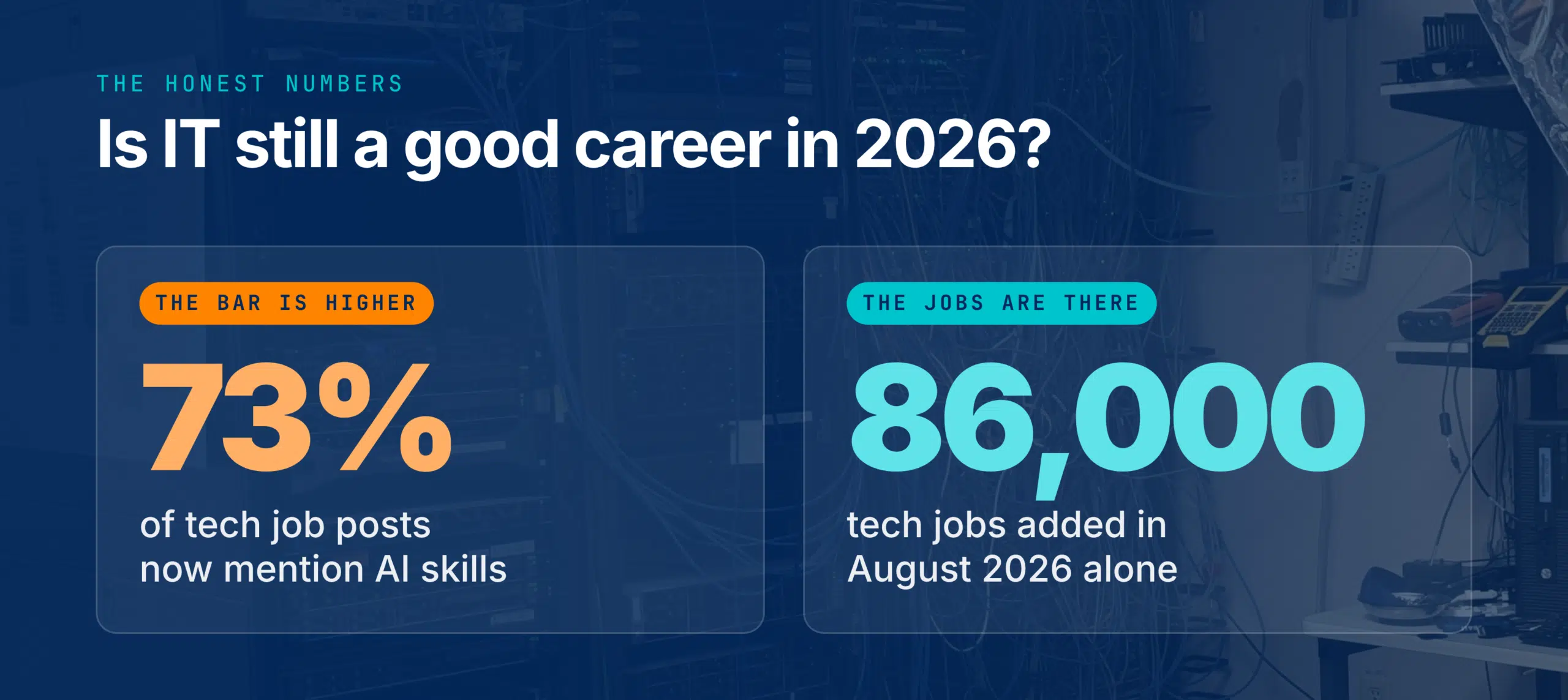
Despite the challenges facing entry-level candidates, the broader IT job market continues to show demand. CompTIA reported the U.S. tech industry added 86,000 jobs in August 2026. Tech unemployment remained below 3%, and employers listed nearly 600,000 open technology positions that month. About 42% of those postings represented newly advertised opportunities.
The industry also faces a steady need to replace workers who retire or leave their jobs. CompTIA estimates employers will need to replace approximately 323,000 tech workers annually through 2036 for those reasons alone.
Artificial intelligence adds another dimension to that demand. LinkedIn’s 2026 labor market research found AI-enabled jobs generated 1.3 million new-collar opportunities worldwide between 2023 and 2025. Meanwhile, Dice analyzed 7 million U.S. job postings and found the share mentioning AI skills rose from 15% in January 2024 to 73% by May 2026.
AI isn’t just changing existing IT jobs. It’s creating new specialties, too. AI red teamers test AI systems for security vulnerabilities and harmful behavior. AI governance professionals develop policies and oversight practices. AI solutions architects integrate AI into business technology environments, while AI trainers and evaluators help assess the quality and reliability of AI-generated output.
These roles barely existed outside specialized teams a few years ago. Now, employers across industries are beginning to define the skills and responsibilities they need.
There’s another important part of the story. Some companies that cut employees in anticipation of AI-driven efficiencies have discovered automation can’t cover every responsibility. A Careerminds survey found roughly two-thirds of companies that made AI-related workforce cuts later rehired for at least some of those positions. Nearly a third said they spent more on rehiring than they saved through the cuts. Forrester research also found 55% of employers regretted AI-related layoffs.
“They’re letting people go, but then they’re bringing them back because they’re realizing they overestimated what AI can do for them,” said Jim Atria, senior live online lead instructor at MyComputerCareer, in a CBS interview.
None of this erases the challenges facing people entering IT. But it does show why headlines about AI replacing workers don’t tell the whole story. Companies are changing how they use technology, and they still need people who know how to make it work.
The Next Chapter of IT Is Still Being Written
The numbers show demand for technology skills, but they can’t tell us exactly what the entry-level IT job market will look like in two or five years. Nobody knows where the new entry-level baseline will settle. Some emerging AI job titles may become established career paths. Others may merge into existing roles or change names as companies refine their needs. The tools that employers prioritize today may look different 18 months from now.
That uncertainty makes career planning harder, especially for someone deciding where to invest time and money. It also makes sweeping predictions about the future of IT unreliable. Anyone who claims to know exactly which IT jobs will thrive, which technologies will dominate or what employers will expect from every new hire is making a prediction, not offering a guarantee.
“Predicting the future, I’ve never been able to do it,” Stanger acknowledged on MyComputerCareer’s Get Into IT Live.
Uncertainty doesn’t mean people have no way to prepare. Technology has gone through major shifts before, from the rise of the internet to cloud computing and mobile technology. Those transitions changed job responsibilities and created new specialties. They also reinforced the value of skills that professionals could carry from one generation of technology to the next.
Consider how cloud computing changed the work of IT professionals. Knowing how to manage physical servers remained useful, but professionals also had to understand virtual environments, cloud infrastructure and new approaches to security. The underlying principles didn’t disappear. The ways professionals applied them changed.
AI is introducing another shift, and the transition will take time. Employers are still figuring out where AI fits into their operations, which tasks it can handle reliably and where human judgment remains essential. Those decisions will influence the roles they create and the skills they seek.
For someone considering an IT career, you don’t have to predict every change before it happens. It’s more important to build a foundation that makes adapting to those changes easier.
Adaptability Starts With a Strong Foundation
AI may feel like an unprecedented disruption, but the IT industry has been here before. The rise of the internet, cloud computing and mobile technology all changed how organizations operated and what they expected from technical professionals. Some job responsibilities disappeared, and new specialties emerged. The roles evolved. The people who built strong technical foundations and stayed willing to learn found ways to adapt. Those who relied too heavily on one specific tool or resisted changing their approach had a harder time keeping pace.
The same principle applies to AI. No one can know exactly which tools or technical specialties will dominate in the coming years. But professionals who understand their field, stay curious and learn how to apply new technology will be better positioned to navigate whatever comes next.
Stanger outlined four areas employers look for when they talk about AI skills:
- Foundational domain knowledge. Professionals need to understand their field before they can use AI effectively within it.
- Real prompting ability. Knowing how to write useful prompts requires more than copying and pasting instructions into a chatbot.
- Efficient use of AI resources. Professionals should understand how to use available tools and resources without wasting time or computing power.
- Comfort working with AI agents. As organizations introduce agents that can complete multistep tasks, employees need to understand how to work alongside them and evaluate their output.
These skills build on a foundation of technical knowledge. AI tools will continue to change, but the principles behind networking, operating systems, cybersecurity and systems administration provide a starting point for learning whatever comes next.
Stanger made a similar point in an interview with CIO, where he described how employers’ expectations for technical professionals have shifted.
“At one time, the industry was looking for IT ‘plumbers’ who could code. Now the industry is demanding people who can think architecturally and in terms of risk and privacy,” Stanger said.
In other words, employers need professionals who can understand how technology fits into a larger environment. A network administrator, for example, needs to know more than how to configure a network. That person must also understand how network decisions affect security, business continuity and the people who rely on those systems.
This is one reason IT certifications remain valuable. Certifications carry more weight than they have in years because they answer the question employers keep asking: if not a degree, what proves your skills? Certifications give employers a way to evaluate foundational knowledge and provide candidates with a structured way to demonstrate what they’ve learned. Certifications in networking, cloud computing and cybersecurity can help establish technical credibility, particularly for people who don’t have years of professional IT experience or degrees in related fields. Certifications work best alongside practical experience. Home labs, hands-on exercises, personal projects and troubleshooting practice help candidates demonstrate they can apply concepts outside a classroom or exam.
Cybersecurity offers a good example. Professionals need to understand networks, operating systems and common vulnerabilities before they can effectively protect an environment. Building those fundamentals can open doors to security-focused training and eventually a cybersecurity career.
Stanger offered a concise way to think about the relationship between technology and work on Get Into IT Live: “If a profession’s not changing, that’s the one that gets automated.”
The main point is that not every IT professional needs to become an AI expert. Rather, people who understand their field and remain willing to learn will have more ways to respond as the industry changes.
Is This Right for You?
IT isn’t for everyone, and it never has been. If you want a career that stays the same for 30 years, this probably isn’t it. Technology will change. Employer expectations will shift. You’ll have to keep learning long after you land your first job. “Never stop learning” sounds great in a blog post and lots of jobs say that about their profession, but in IT, it’s a real commitment.
But if you like figuring things out, solving problems and understanding how things work, there’s a lot to explore. The industry has rewarded people with those instincts for decades, and the demand for technical skills isn’t disappearing. The roles may change, but organizations will still need people who can evaluate technology, manage risk and put the right tools to work.
The bar for entering IT is higher than it used to be, but that doesn’t mean it’s out of reach. A solid foundation, relevant certifications and hands-on experience can help you build the skills employers need. If you want to see what that preparation can look like, MyComputerCareer’s training programs might be a good first step.
The decision comes down to whether you’re willing to keep learning as the work changes. If you are, there’s room to build a career in IT.