
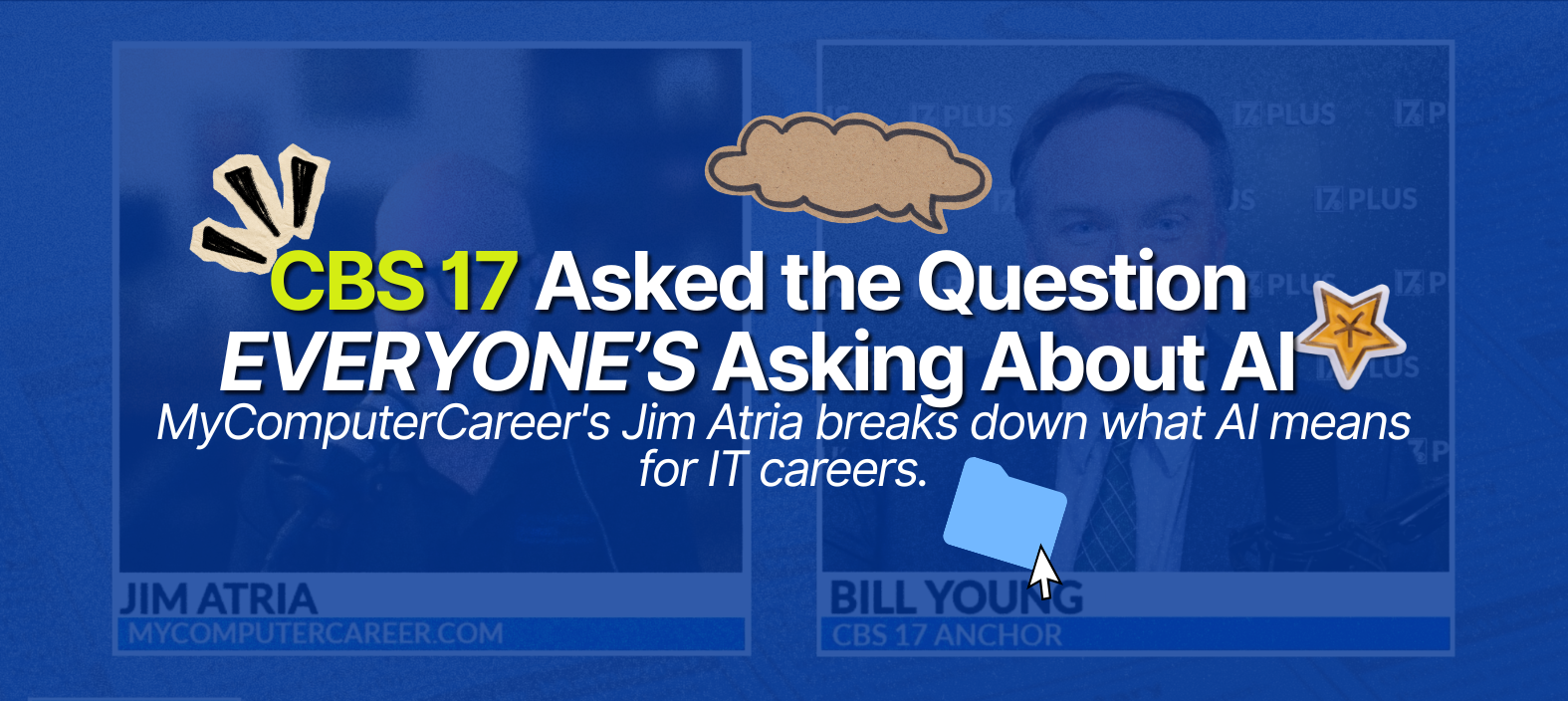
Jim Atria has been earning IT certifications since 1994. He teaches them daily as senior live online lead instructor at MyComputerCareer. He breaks down the biggest IT and cybersecurity headlines each week on our IT Blitz series. So when CBS 17’s Bill Young wanted someone to cut through the noise around AI and IT careers for the station’s Job Alert segment, Jim was the right call.
Spoiler: he doesn’t think AI is coming for your job. But his reasons go deeper than the usual “don’t worry about it.”
Are Companies Replacing IT Workers With AI?
Some tried. It didn’t go well.
Jim pointed to a pattern showing up at Ford, Taco Bell, Oracle, and Microsoft: companies cut staff expecting AI to handle the workload, then brought people back when it couldn’t.
“They’re letting people go, but then they’re bringing them back because they’re realizing that they overestimated what AI can do for them,” Jim said.
AI isn’t eliminating IT jobs. It’s reshaping them. “AI is not replacing your job,” he said. “It’s just your job went from doing this to now supporting the AI.”
He compared the moment to the dot-com boom of the late ’90s. Everyone rushed in, a correction hit, but the technology didn’t disappear. It matured. The people who stuck with it and kept building skills built lasting careers. Jim sees AI on the same path: a shakeout is coming, but the technology is here to stay, and the people who understand how to work with it (and where it falls short) will be the ones still standing.
How Reliable Is AI When It Comes to Getting Answers Right?
Not as reliable as most people assume. Jim has a go-to classroom demo to prove it.
He asks AI how often you should lube your car’s “muffler bearings.” For anyone who isn’t a car person: muffler bearings don’t exist. Jim puts them right up there with blinker fluid.
AI doesn’t flinch. It delivers a thorough, confident answer about preventative maintenance for a part that was never a thing.
“AI is there to kind of make you feel good and give you the answer it wants you to have, not necessarily the right answer,” Jim said.
He told Bill that AI performs best when you hand it a small, contained task. Ask it to summarize a PDF or clean up a spreadsheet, and it does great work. But the bigger and messier the ask, the more likely it is to start generating polished nonsense with complete confidence. That’s the gap professionals need to understand if they’re going to use AI as a tool instead of treating it like an authority.
Why Do Employers Keep Talking About Soft Skills?
Because AI can’t do them.
Jim put it bluntly: AI “knows how to speak well,” but “there’s not a lot of substance behind it.” Communication, critical thinking, understanding nuance, helping someone else navigate a confusing new tool. Those are the skills that separate a strong candidate from someone who just looks good on a resume.
Bill backed this up from the hiring side. He noted that recruiters at companies like Lenovo have seen candidates game AI-powered screening systems to land interviews, only to fall apart once a human gets on the phone.
What Should IT Job Seekers Focus on Right Now?
Jim’s advice was direct. Build a home lab. Use free resources (YouTube is packed with them). And don’t sleep on IT certifications.
Certifications solve two problems most job seekers overlook. First, they help you get past AI-powered applicant tracking systems (ATS) that filter resumes before a human ever reviews them. Jim urged viewers to research how ATS works, because too many qualified people never make it past that automated filter. Second, certifications let you specialize. Whether it’s CompTIA, Cisco, Amazon, Google, or Microsoft, a certification tells employers you have verified skills and the discipline to earn them.
MyComputerCareer’s IT training programs follow the same approach. Students learn a concept in class, then sit down with a hands-on lab that reinforces it through repetition and practice. Jim has lived this model longer than most. He earned his first certification in 1994 and has never stopped adding new ones. He picked up another just weeks before taping this segment.
“Education is a journey,” Jim said. “It’s not a destination.”
The Bottom Line
AI shows up in every corner of IT now, from help desk support to cybersecurity to the hiring process itself. But Jim’s message throughout this conversation stayed consistent: learn the tool, understand where it breaks down, keep building hands-on skills, and double down on the human qualities AI can’t fake.
As Bill told viewers at the close of the segment: breathe deep, and keep moving forward.
Watch the full CBS 17 Job Alert segment with Jim Atria here.
Thinking about building the skills and certifications that keep you competitive? Take our free career evaluation or explore our programs to get started.
Frequently Asked Questions
Will AI replace IT jobs? Current evidence says no. Companies like Ford, Oracle, and Microsoft cut IT staff expecting AI to cover the gap, then had to bring people back when it couldn’t deliver. AI is changing what IT work looks like, not eliminating it. Most shifts involve supporting, building, or managing AI systems.
What skills do IT professionals need alongside AI? Communication, critical thinking, and the ability to train others on new tools are growing in demand as AI handles more routine technical tasks. IT certifications from organizations like CompTIA, Cisco, and Microsoft help professionals demonstrate verified, in-demand skills.
How does AI affect the IT hiring process? Many employers use AI-powered applicant tracking systems to screen resumes before a human reviews them. Earning IT certifications and tailoring your resume with relevant keywords can help you get past these automated filters.
Are IT certifications still worth pursuing? Yes. Certifications validate specific technical skills, help candidates pass AI-driven resume screening, and let IT professionals specialize in high-demand areas like cybersecurity, cloud computing, and networking. Not sure if IT is the right fit? Here are 7 signs to consider.